In The Beginning, part II

Welcome back! In the prior newsletter, I shared the beginning of Chapter 1 of Free The Bird, the book I’m writing about the incredibly strange story I’ve been living for the past three years.
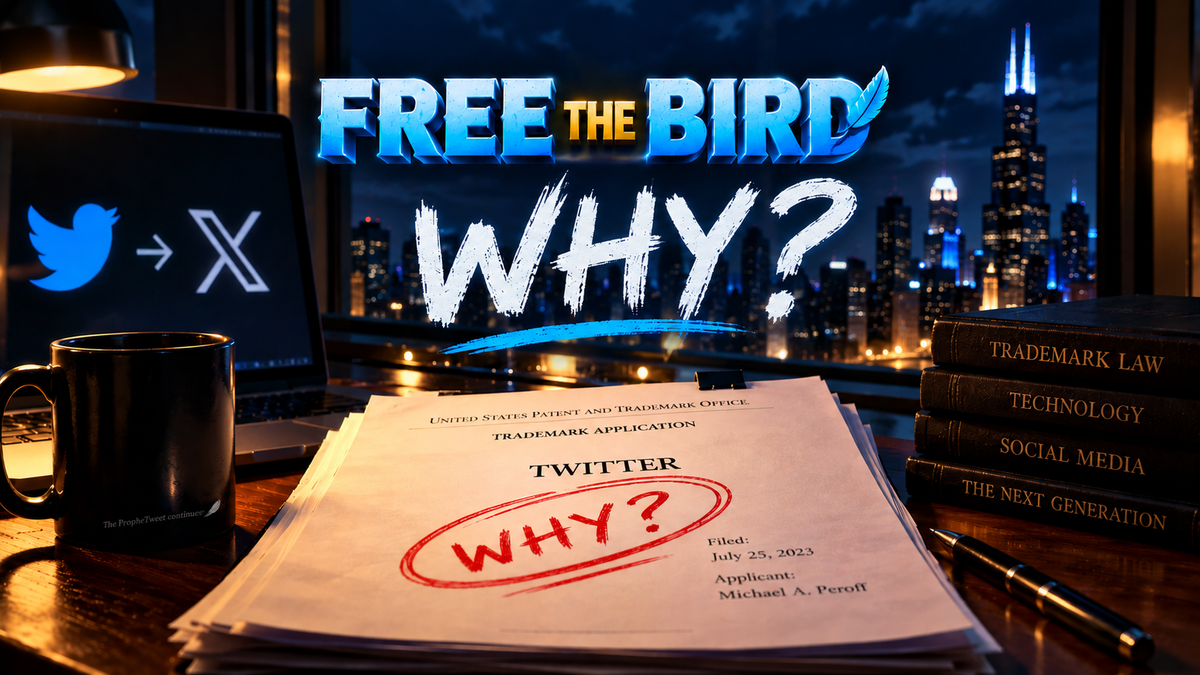
It explained what happened on July 25, 2023 after Elon Musk announced that Twitter would become X and that I filed a federal trademark application for TWITTER.
But it stopped before the more important question: Why?
I thought about cutting the rest down for a proper newsletter. Instead, I’ve decided not to. This is the remainder of Chapter 1. If I’m going to tell this story, I might as well tell it right.
• • •
Here’s the thing: In the 24 hours since Elon Musk made the announcement that Twitter would become X, I couldn’t stop ruminating over one thought: Twitter was not a globally recognized brand worth billions of dollars just because of the technology or the intellectual property. Twitter changed the way the world communicated information in real time via short, written messages. And that mattered. It mattered on such a global scale that a single tweet could, and did, impact events of global and historical importance.
From its inception in 2006 through 2023, Twitter had grown into the go-to social media platform, particularly for breaking news. World events were being narrated in real time not just by journalists and politicians, but by millions of regular, everyday users who made up the “Twitterverse.” It felt like the whole world was using Twitter to communicate information and seek connection, whether to make friends or document history. Social media in general, and as a mass-adopted technology, had grown to become a routine part of daily life for people all over the world, and Twitter made up a substantial portion of it.
I recalled world-changing events on Twitter such as watching the Arab Spring unfold in 2010, and more recently, Russia’s war on Ukraine in 2022, with instantaneous reports, images and videos from Ukrainians about the absolute horror being unleashed on them. Even at its height, most American adults did not use Twitter, but they were impacted by it all the same.
To me, the purchase by Mr. Musk and ensuing changes to the platform felt like a betrayal of the purpose that Twitter originally served: to be an open communication platform that genuinely tried to serve the public (and global) interest. Personally, Twitter helped me better understand and interpret the world I lived in because I could see in my feed what was happening day after day and how ordinary people like me were reacting to it. My feed was geared toward news and current events, so that is what I noticed changing most after Mr. Musk’s acquisition.
Maybe it was because of Covid, or maybe it was just because of the political environment that existed in 2023, but it came to feel like the very fabric of our shared reality was becoming more and more fractured. Having survived my first pandemic while trying to raise two young kids right after watching the events of January 6, 2021, I couldn’t help but ask myself: How is any of this real? Like, did we all die and this is hell?
At the time, and it generally remains true today, spending ten minutes on social media was enough to break anyone’s brain with the daily onslaught of outrage-inducing and anxiety-producing posts. Using the platform left me feeling more exhausted than anything else, and annoyed or worse. Social media became so toxic to me that it sometimes felt as though my daily information feed was being weaponized against me.
At the same time, Twitter felt like my connection to the outside world after I had spent so much time at home since 2020 because of Covid. So to me, the disappearance of such a critical communication platform struck me as not just heartbreaking, but unacceptable. For reasons that would only become clear to me later, I felt a personal responsibility to do something about it. I felt like when you have the power, or even just an opportunity, to do something, and you don’t, and then bad things happen, it really is kinda your fault.
That was my rationale for filing the trademark application. I felt in that moment that if there was a chance, even one in a trillion, to bring Twitter back, then the failure to even try would be the biggest risk of all. And based on the countless perspectives shared with me personally and all over social media about the end of Twitter and what it meant, I knew I wasn’t alone in feeling this way.
I wish I could say that I understood exactly why I felt so strongly about it. I didn’t. Maybe it was intuition. Maybe fifteen years of practicing trademark law had taught me to recognize an unusual opportunity before I could fully articulate what I was seeing. Maybe I was David staring up at Goliath. Or maybe I was Don Quixote staring at a windmill.
I had no way of knowing.
But that was the point. How could I know if I didn’t try?
I thought to myself that if there was a path to building a new Twitter, I might be able to find it.
I did not pursue this idea out of a desire for money or fame, but because I knew something important was being lost. Increasingly, it felt like the world was careening toward disaster, and since Twitter, and I would argue social media more broadly, had become a huge part of the problem, then perhaps it could also become the best tool to help solve it.
Before I fell asleep that night, I had one overriding concern: my kids. If I didn’t pursue this, would my kids get to experience the same world of opportunity as I did, or would it collapse into tribalism and conflict, robbing them of any chance at a peaceful and meaningful existence? My kids are the most important thing in the world to me, and when I tried to imagine what their futures might look like based on the trajectory I saw around me, the scenarios were pretty grim. I didn’t know whether I could make any meaningful difference under any circumstance. But if there was even a possibility of building a better future for them, I felt an obligation to try.
In the immediate aftermath of filing the trademark application, nothing much changed as the world moved on. I went back to trying to build my fledgling law practice while keeping an eye on Elon Musk’s pronouncements and actions regarding the rebrand of Twitter. But as summer turned to fall in 2023 and it became clear that Mr. Musk was indeed serious about permanently rebranding the platform to X, the trademark application I filed became my own version of The Tell-Tale Heart. It was like a lottery ticket sitting in the corner, constantly vying for my attention no matter how hard I tried not to think about it. What started as a minor distraction became a borderline obsessive demand on my time and attention.
As 2023 came to a close, and I closely studied the transformation of Twitter to X, I saw an opportunity to do something seemingly impossible: build a new Twitter. Once I was convinced it was an actual possibility, I no longer had an excuse not to try.
The path became clear. If I was going to build a new Twitter, I was going to have to pick a legal fight with perhaps the most powerful person on the planet for the rights to one of the most valuable trademarks in history: Twitter.
In that moment, I thought I was fighting for a brand. I would eventually come to understand that I was fighting for something much larger: a future worth building not just for me and my kids, but for everyone.
• • •
Free The Bird is a work in progress. This is how it began. I can't explain where things are today and where they may go in the future if I don't lay the proper foundation. As always, all feedback welcome in the comment section below!